Dior SS26 Boutique Merchandise Review: Gaps and Opportunities

Updated: Jan 5
On January 2, items from Jonathan Anderson’s debut collections for Dior arrived in boutiques. For now, the focus is on menswear — the collection was shown in summer 2026 — while the womenswear offer remains limited, with broader assortment updates expected in February. I reviewed the new arrivals in boutiques and online, and here are my thoughts.
The team has done an excellent job on the product pages in the online shop. The photography is of outstanding quality, allowing garments to be examined in detail without losing artistic intent — love the backgrounds! I didn’t analyse the site structure as a whole, so I can’t assess how thoughtfully the overall client journey has been designed.
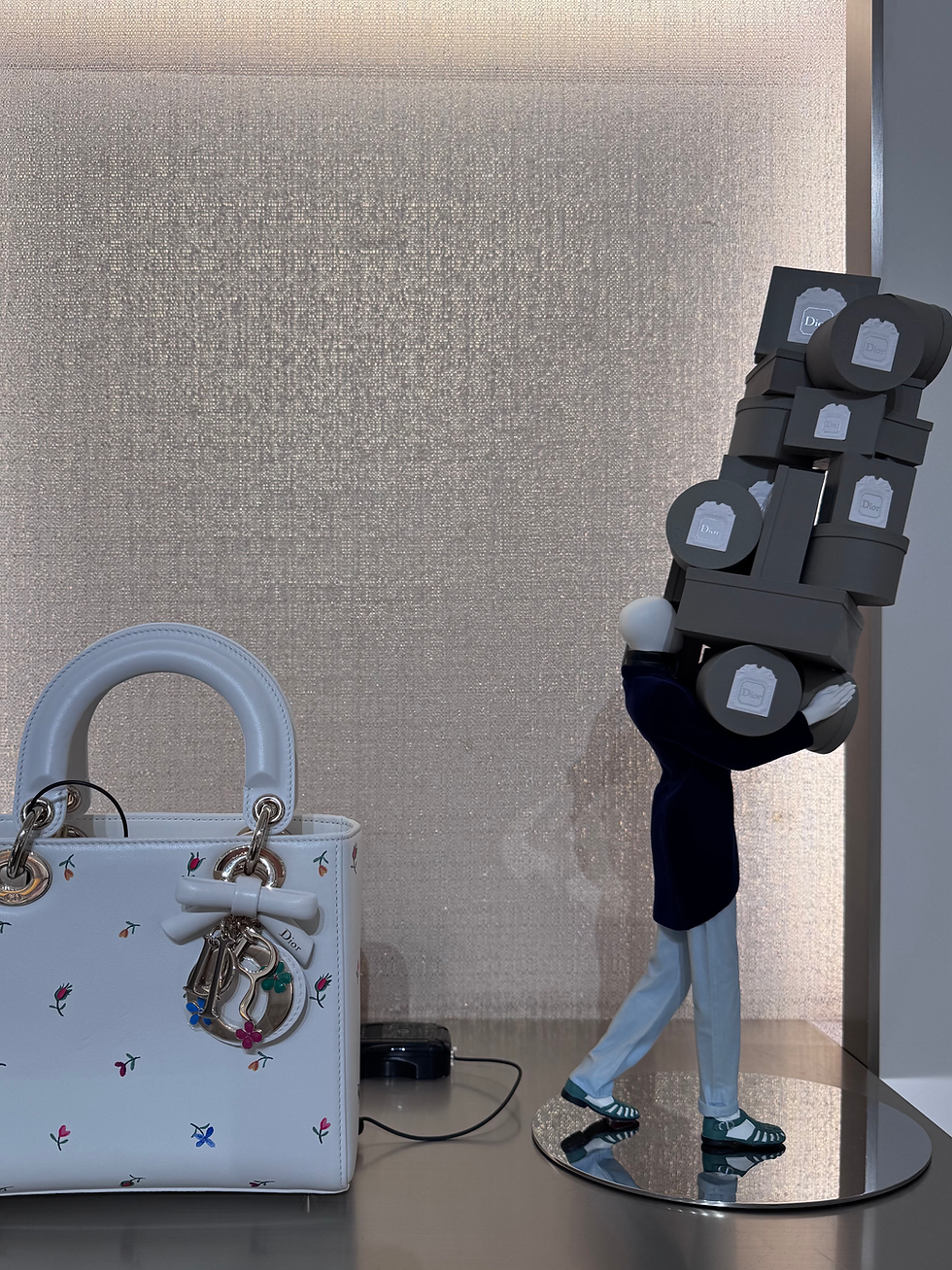
In boutiques, the visual transformation is still in progress. Store windows are covered with large grey posters, while small figures carrying boxes have already appeared on shelves. They echo last year’s Loro Piana window concept at Harrods. The Dior boxes they carry also appear updated. I didn’t make a purchase myself, so I can’t confirm whether this will be the final packaging, but it would be a logical continuation.
Assortment
What has arrived in boutiques so far is unified by two main themes.
The first is books. The updated book totes — previously teased and now resembling literal book covers — appear not only as bags, but across small leather goods, basic merchandise such as T-shirts and sweatshirts, as well as jackets and knitwear. The Book Tote as a product has accumulated a considerable amount of baggage of its own: following the brand’s lack of response to the sweatshop controversy within its production chain, the item has become surrounded by narratives that extend well beyond design. As a result, part of the trend-driven audience no longer perceives the Book Tote as a desirable object, regardless of how it is reinterpreted.
The second theme is embroidery, most notably clover motifs, which appear on shirts, skirts, and sweaters, shoes. In womenswear, clover embroidery is also present. All motifs are executed as embroidery rather than prints.
In menswear, themes extend to a tailoring narrative — spools of thread and measuring tapes brooches on T-shirts, and sweaters. Conceptually, the idea is clear, but it is very niche and difficult to scale meaningfully.
Focus
In-store, the menswear presentation places strong emphasis on footwear and ties. I saw a young man stopping his father and pointing to a tie with genuine interest. This kind of entry-level product clearly has potential among a young, preppy audience.
Beyond these points, much of the menswear offer feels extremely ordinary. The bar jacket, while curious as a concept, is unlikely to gain traction in everyday life. As with the ties, it’s difficult to imagine it resonating with anyone over 30 or outside a size M.
Womenswear
Across several boutiques, the focus is on the striped polo from the campaign, offered in two colours. The price is £1,650 for 100% cotton. This feels like a price driven by visibility and advertising rather than by the product itself — an obvious miscalculation. For the piece to work, it would need either a significantly lower price and a limited run, or a more complex and genuinely luxurious material.
Overall, the women’s department feels very safe and somewhat anonymous. Many pieces are reworked from the Maria Grazia Chiuri era: familiar silk pyjamas in an upbeat floral, classic two-piece suits, and a large amount of basic merchandise featuring embroidered Dior Book motifs. In several locations, tweed three-piece sets — jacket, skirt, and coat with sequins — are highlighted separately at the display.
The Dior Bow bag is being actively pushed both in-store and on social media. I’ve written about it before, but I’ll repeat myself: it looks like a fairly generic mass-market design and is unlikely to gain real traction at a £3,250 price point.
Quality
The heavy reliance on embroidery is worth flagging. While this may be acceptable on shirts, in the case of cotton T-shirts and knitwear it raises concerns about wear over time, as the embroidery itself is big and often makes a frame. After a few washes, the fabric will inevitably stretch or shrink, while the embroidery remains fixed.
I also tried on two bar jackets. The flannel version is so soft, and so lacking in structural reinforcement, that the pocket was already buckling even without movement. This is difficult to justify for a statement piece.
The women’s cropped boxy jackets showed similar issues, buckling around the closures even on the hanger. I’m not convinced this fully resolves once worn.
The focus in the collections is on decorative detail rather than on fit and tailoring — precisely the areas where the brand traditionally excels.
Overall assessment
After an overexposed PR campaign, what arrived in boutiques offers little that feels genuinely new. The offer boils down to fairly trivial basics carrying a Dior label and the associated price point.
The only genuinely strong fashion piece in the women’s department is a silk dress that appeared twice over the summer in pink and blue. Its price — £13,000 — clearly excludes the vast majority of clients.
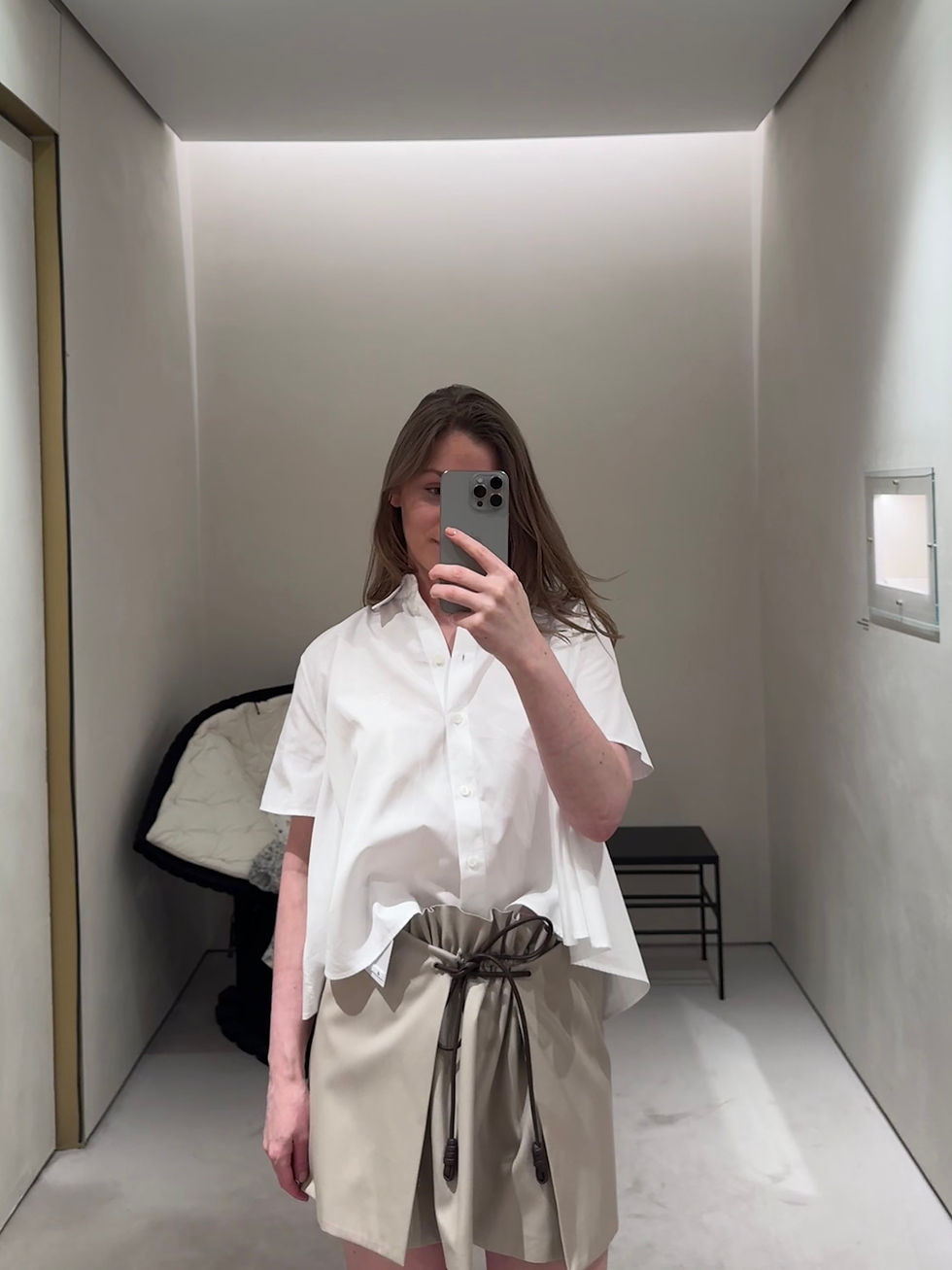
Instead, customers are offered a very simple silk blouses with short sleeves, basic in both cut and colour (black and white), priced at £1,700.

Revisiting the women’s runway collection, the underlying issue becomes clear: too many directions, and not enough editing, make it difficult to translate the show into a compelling boutique offer. To generate interest, I would focus on two themes.
The first is the mentioned pleated dress. It lends itself naturally to being broken down into tops and bottoms in various combinations. Instead, the idea has been translated into a plain blouse with overly long bow — without pleating, without pastel colours — effectively stripping it of what made it desirable.
This pleating reminded me of a dress from a Raf Simons collection that I once shamelessly copied. I worked with a separate specialised atelier to achieve the pleating. While such garments require roughly twice as much silk, the pleating process itself is not complex or expensive enough to justify a £13,000 price tag. In other words, the barrier here is not technical feasibility, but decision-making.